


Introduction
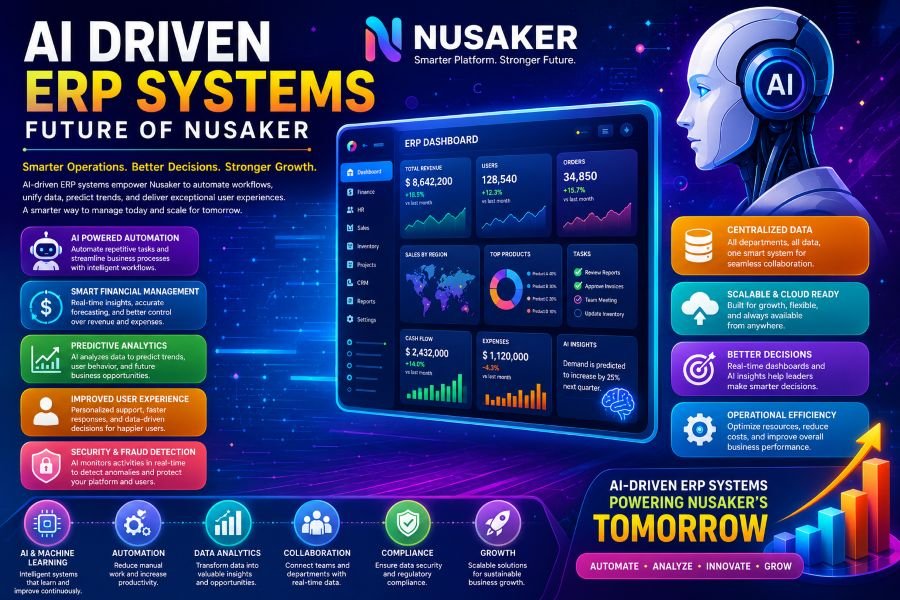
The AI driven ERP systems future of Nusaker describes how artificial intelligence may change the way Nusaker manages its daily operations, business data, finances, users, content, and future planning.
An ERP, or Enterprise Resource Planning system, brings important business activities into one connected platform. When artificial intelligence is added, the system can analyse information, automate repeated work, identify unusual activity, predict future needs, and help people make faster decisions.
Microsoft, SAP, and Oracle already offer ERP platforms with built-in AI, automation, predictive insights, and intelligent assistants. This shows that AI-supported ERP is becoming a practical business technology rather than only a future idea.
Important Research Note
The identity of Nusaker is not presented consistently across the internet. Some third-party articles describe it as a nonprofit network, while others call it a gadget review platform or an enterprise technology business. However, the current Nusaker website describes itself as an online gaming and game-recommendation platform.
For this reason, this article examines Nusaker as a general digital business case study. It does not claim that a verified Nusaker organisation has officially installed a particular ERP product.
What Is an AI-Driven ERP System?
An AI-driven ERP system is business management software that combines traditional ERP functions with artificial intelligence.
A traditional ERP system mainly collects, stores, and organises information. It may connect departments such as:
- Finance
- Human resources
- Sales
- Inventory
- Purchasing
- Customer service
- Supply chain management
- Project management
An AI-driven ERP system goes further. It can examine patterns in business data, recommend actions, automate repeated processes, predict possible results, and alert managers when something appears unusual.
IBM explains that modern AI-enabled ERP systems can automate tasks such as invoice processing and order management. They can also provide real-time insights that help businesses respond more quickly to changing conditions.
How AI-Driven ERP Differs From Traditional ERP
Traditional ERP systems usually depend heavily on people entering information, producing reports, and deciding what should happen next.
AI-driven systems can support these activities automatically.
For example, a traditional system may show that product demand increased last month. An AI-driven system may examine several months of information, predict future demand, and recommend how much stock the business may need.
The main difference is simple:
Traditional ERP explains what has already happened. AI-driven ERP can also help predict what may happen next.
However, AI recommendations should still be reviewed by trained people. Artificial intelligence can make mistakes when information is missing, inaccurate, outdated, or poorly organised.
Why AI-Driven ERP Could Matter for Nusaker
A growing digital platform can collect large amounts of information from users, advertising, content, payments, applications, partners, and customer questions.
Managing this information through separate spreadsheets or disconnected software can become difficult. Important details may be repeated, lost, delayed, or entered incorrectly.
An integrated ERP platform could give Nusaker one organised view of its operations. AI could then help the business understand that information and use it more effectively.
Microsoft states that its Dynamics 365 applications combine AI agents, Copilot tools, and built-in AI features across ERP and CRM functions. These capabilities can analyse data, automate tasks, and guide decisions involving finance, supply chains, sales, and customer service.
1. Automation of Repeated Tasks
One major benefit of AI-driven ERP is automation.
A digital business may complete many repeated tasks every day, including:
- Entering payment information
- Organising invoices
- Updating records
- Preparing reports
- Answering common questions
- Checking transactions
- Managing approval requests
- Sorting customer messages
AI can complete or support many of these activities. This may reduce manual work and allow employees to spend more time on planning, creativity, user support, and business development.
Automation does not mean that people are no longer needed. Human review remains important, especially for payments, legal matters, customer complaints, security decisions, and unusual transactions.
2. Better Financial Management
An AI-driven ERP system could help Nusaker bring income, expenses, invoices, subscriptions, advertising payments, and financial reports into one platform.
AI may assist by:
- Matching invoices with payments
- Detecting duplicate entries
- Finding unusual spending
- Predicting cash requirements
- Preparing financial summaries
- Sending payment reminders
- Supporting budget planning
Oracle says its cloud ERP platform uses AI to automate manual processes and analytics to help teams react to market changes in real time.
The final financial decisions should still remain with qualified people. AI should support financial control, not replace responsible review.
3. Smarter Forecasting and Planning
Forecasting is the process of estimating what may happen in the future.
For Nusaker, forecasting could include predicting:
- Website traffic
- User activity
- Advertising income
- Server demand
- Customer support volume
- Popular content categories
- Application downloads
- Seasonal changes
AI can study previous information and identify patterns that may be difficult for a person to see quickly.
This could help Nusaker prepare resources before demand rises. It may also help the platform avoid spending too much money on areas that are receiving little interest.
Forecasts are not guarantees. Unexpected events, market changes, technical problems, and changes in user behaviour can make predictions inaccurate.
4. Improved Customer and User Experience
An AI-driven ERP system could connect operational data with customer relationship management tools.
This may help Nusaker understand:
- Which services users visit most often
- Which questions users commonly ask
- Where users leave the platform
- Which complaints require urgent attention
- Which services create the most engagement
- How quickly support requests are answered
AI assistants may also organise customer requests, suggest answers, summarise previous conversations, or send cases to the correct team.
The system should clearly tell users when they are communicating with an automated assistant. Complicated, sensitive, or unusual problems should be passed to a human employee.
5. Real-Time Business Information
Older business systems often produce reports after information has already become outdated.
Modern cloud ERP platforms can bring information together more quickly. Managers may be able to view current financial activity, user demand, operational problems, and team performance from one dashboard.
SAP describes cloud ERP as a system that offers real-time insights, embedded AI, and connected capabilities across finance, procurement, and supply-chain processes.
For Nusaker, faster information could improve decisions about content, advertising, technical resources, partnerships, and customer service.
6. Stronger Security and Fraud Detection
Digital businesses may face fake accounts, unusual payments, automated attacks, suspicious downloads, and unauthorised access attempts.
AI can examine system activity and flag behaviour that appears different from normal patterns.
For example, it may identify:
- Repeated failed login attempts
- Unusual payment activity
- Sudden changes in account behaviour
- Unexpected access to business records
- Large numbers of automated requests
- Transactions that do not match normal patterns
IBM notes that AI can continuously monitor systems and help identify security threats or unusual activity more quickly.
AI security tools should be part of a wider security plan that includes encryption, access controls, backups, software updates, employee training, and human investigation.
7. Connected Departments and Data
A business can lose time when finance, marketing, support, management, and technical teams all use separate systems.
An ERP platform creates a shared source of information. When one authorised team updates a record, other authorised teams can receive the updated information without creating another copy.
This can reduce:
- Duplicate records
- Conflicting reports
- Repeated data entry
- Delayed approvals
- Communication problems
- Missing information
Connected data is valuable, but access must be controlled carefully. Employees should only be able to view the information required for their work.
Possible Challenges for Nusaker
The AI driven ERP systems future of Nusaker also includes several risks and difficulties.
Poor Data Quality
AI depends on the information it receives. If business data is incomplete, repeated, incorrect, or stored in different formats, the system may produce weak recommendations.
Before using AI, Nusaker would need to organise and clean its information.
IBM recommends careful data governance, scalable infrastructure, continuous monitoring, and an integration strategy connected to business goals.
Implementation Costs
ERP projects may involve software subscriptions, technical support, data migration, employee training, cybersecurity, and system customisation.
A business should not purchase every available AI feature immediately. It is usually safer to begin with one useful process and expand after the system produces clear value.
Employee Training
A new ERP platform changes how employees complete their work.
Without proper training, people may avoid the system, enter information incorrectly, or continue using old spreadsheets. Nusaker would need simple training, clear responsibilities, and ongoing support.
Privacy and Security
ERP platforms may contain sensitive information about payments, users, employees, partners, and business performance.
Nusaker would need clear rules covering:
- Who can access data
- How long information is stored
- How data is protected
- Which AI tools may use the information
- How errors are reported
- When human approval is required
Too Much Dependence on Automation
AI should not be allowed to make every important decision automatically.
Incorrect automation could block a genuine customer, approve a suspicious transaction, produce an inaccurate forecast, or send an unsuitable response.
Important decisions should include human review and a clear method for correcting mistakes.
A Practical Implementation Plan
Nusaker could follow a gradual process rather than replacing every system at once.
Step 1: Identify the Main Problem
The business should begin with a clear problem, such as slow invoice processing, repeated data entry, weak reporting, or delayed customer support.
Step 2: Review Existing Data
Nusaker should check whether its records are accurate, complete, secure, and legally collected.
Step 3: Choose a Small Use Case
A suitable first project might include invoice matching, support-ticket organisation, monthly reporting, or demand forecasting.
Step 4: Compare ERP Platforms
The company should compare features, cost, security, integration, support, scalability, and ease of use.
Step 5: Keep Human Approval
Important financial, security, and customer decisions should require human confirmation.
Step 6: Train Employees
Employees should understand how to use the system, review AI suggestions, report mistakes, and protect business data.
Step 7: Measure Results
The company should measure whether the system saves time, reduces errors, improves service, or supports better decisions.
Step 8: Expand Carefully
Additional AI functions should be introduced only after the first project works reliably.
The Future of AI-Driven ERP Systems
The next stage of ERP development is likely to include more intelligent assistants and AI agents.
Instead of only showing reports, these systems may prepare documents, recommend actions, complete approved workflows, explain financial changes, and help employees find information through normal language questions.
Microsoft, SAP, and Oracle are already developing ERP products around AI assistants, embedded intelligence, automation, and agent-based workflows.
The most useful systems will not simply include the largest number of AI features. They will provide accurate information, understandable recommendations, strong security, clear human control, and measurable business value.
Will AI-Driven ERP Replace Employees?
AI-driven ERP is more likely to change many jobs than remove the need for people completely.
Repeated administrative work may decrease. At the same time, businesses will continue to need people who can:
- Review unusual situations
- Make responsible decisions
- Communicate with customers
- Protect private information
- Correct inaccurate AI results
- Plan business strategy
- Manage creative work
- Supervise automated processes
The best result is cooperation between people and technology. AI handles suitable repeated work, while people provide judgement, responsibility, creativity, and understanding.
Frequently Asked Questions
What are AI-driven ERP systems?
AI-driven ERP systems are business management platforms that use artificial intelligence to automate tasks, analyse information, predict possible outcomes, and support decision-making.
What does Nusaker mean in this keyword?
Online sources describe Nusaker in different ways. Its current website presents it as a gaming platform, while some third-party articles use the name for other types of organisations. Therefore, the term should be treated carefully unless an official business identity is provided.
How could an AI-driven ERP system help Nusaker?
It could help organise financial records, automate repeated tasks, improve customer support, analyse user activity, detect unusual behaviour, and support future planning.
Can a small business use AI-driven ERP?
Yes. Cloud-based and modular ERP platforms can allow smaller organisations to begin with selected functions instead of installing a large system all at once.
Is AI-driven ERP secure?
It can include useful security and monitoring features, but no system is automatically safe. Strong access controls, encryption, backups, employee training, updates, and human monitoring are still required.
Does a business need to replace its current ERP system?
Not always. Some existing ERP platforms can be extended with AI assistants, automation tools, analytics, or connected applications. The correct choice depends on the condition and compatibility of the existing system.
What is the biggest risk when using AI in ERP?
Poor-quality data is one of the biggest risks. AI may produce inaccurate suggestions when the information used by the system is incomplete, incorrect, or biased.
Conclusion
The AI driven ERP systems future of Nusaker is centred on connected data, intelligent automation, faster reporting, predictive planning, improved security, and better business control.
For Nusaker, the safest approach would be to begin with a clearly defined problem, prepare accurate data, introduce one useful AI function, train employees, and measure the results.
AI-driven ERP should not be treated as a system that runs an entire business without people. Its real value comes from helping people complete routine work more efficiently and make better-informed decisions.
With careful planning, strong data governance, human supervision, and suitable security, AI-driven ERP technology could provide a flexible foundation for Nusaker’s future digital operations.
