


Introduction
People searching for FintechZoom SP500 are usually trying to understand the S&P 500 market, check its movements, or find simple information about major U.S. stocks.
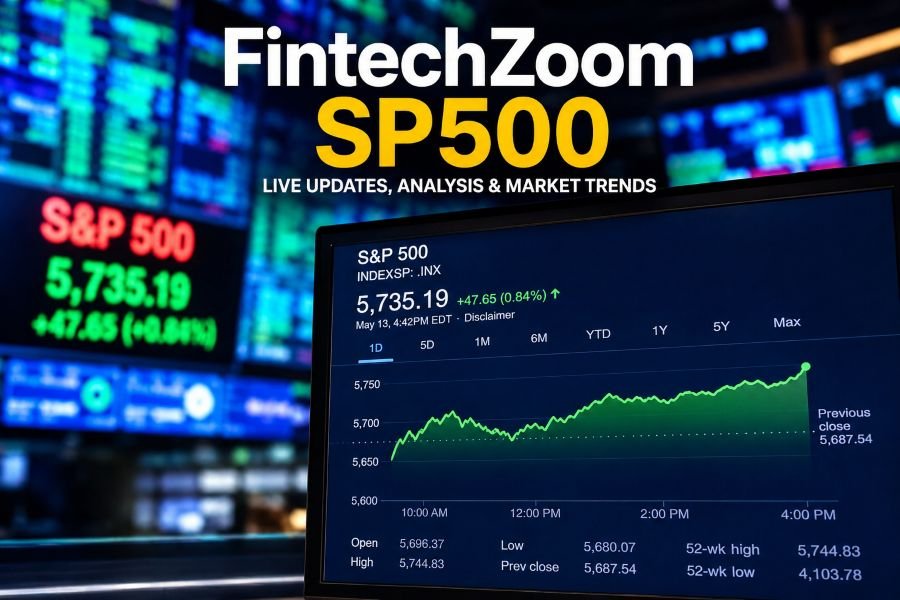
FintechZoom has a dedicated S&P 500 section that combines market information, charts, related news, analysis, and educational content about the famous U.S. stock index. Its page describes the service as an S&P 500 analysis tool designed to provide market insights and updates.
However, understanding the information on a market website becomes much easier when you first know what the S&P 500 actually represents.
The S&P 500 is one of the world’s most closely followed stock-market benchmarks. It tracks 500 large U.S. companies and is commonly used as a broad measure of the large-cap American equity market.
This guide explains FintechZoom SP500 in simple language, including how the index works, what information users may find useful, and what beginners should understand before making investment decisions.
Quick Facts
| Quick Fact | Details |
|---|---|
| Main topic | S&P 500 market tracking |
| Platform | FintechZoom |
| Index covered | S&P 500 |
| Index provider | S&P Dow Jones Indices |
| Number of constituent companies | 500 |
| Main market | United States |
| Market segment | Large-cap U.S. companies |
| Weighting method | Float-adjusted market capitalization |
| Direct investment in index possible? | No |
| Common investment method | Index funds and ETFs |
| Information commonly followed | Index movements, charts, news and market trends |
| Suitable for beginners? | Useful for learning, but investment research should not rely on one source alone |
What Is FintechZoom SP500?
FintechZoom SP500 generally refers to the S&P 500 information and analysis available through FintechZoom.
The platform maintains a dedicated page for the Standard & Poor’s 500 Index. It presents an S&P 500 market section alongside charts, related articles, index coverage and educational information.
For a beginner, it can work as a starting point for answering questions such as:
- Is the broad U.S. stock market rising or falling?
- What is happening around the S&P 500?
- Which major market events are attracting attention?
- How does the index work?
- What investment products follow the index?
The key point is that FintechZoom does not create or manage the S&P 500. The benchmark itself is maintained by S&P Dow Jones Indices. FintechZoom is a financial-information platform covering the index.
What Is the S&P 500?
The S&P 500 is an equity index representing the large-cap segment of the U.S. stock market.
According to S&P Dow Jones Indices, it contains 500 constituent companies and is widely treated as a proxy for the U.S. equity market.
Rather than examining only one company, the index combines the performance of hundreds of major businesses.
This makes it useful for understanding the broader direction of large American stocks.
When many heavily weighted S&P 500 companies rise, the index can move higher. When major components decline, the overall benchmark can fall.
It is therefore much broader than watching the share price of a single business.
How Does the S&P 500 Work?
One important detail is that every company in the index does not receive the same weight.
The S&P U.S. indices use float-adjusted market capitalization weighting. In simple words, larger publicly available market values normally have a greater influence on the index than smaller ones.
Imagine two fictional companies:
Company A has a very large market value.
Company B has a much smaller market value.
If Company A represents a larger part of the index, a significant movement in its share price can affect the S&P 500 more strongly than an equal percentage move in Company B.
This is why investors often pay close attention to the biggest companies inside the benchmark.
What Can You Learn From FintechZoom’s S&P 500 Coverage?
The FintechZoom S&P 500 section is designed around market tracking and financial information.
Its dedicated page includes an S&P 500 market section, chart-related information, market articles and educational material connected with the benchmark.
For everyday readers, this information can help with several tasks.
Checking Market Direction
One of the simplest uses is understanding whether the broad large-cap U.S. market is moving upward or downward.
A rising index generally means the combined weighted performance of its constituent stocks has increased.
A falling index means the opposite.
However, the headline movement does not mean every company inside the S&P 500 moved in the same direction.
Reading Market News
Market movements often happen alongside economic announcements, company earnings, interest-rate expectations, geopolitical events and changes in investor sentiment.
FintechZoom regularly publishes coverage involving U.S. markets and major indices, including the S&P 500.
News can provide context, but investors should separate confirmed facts from predictions.
A headline explaining why markets moved is not the same thing as a guarantee about what will happen tomorrow.
Understanding Historical Movement
Charts can help users see whether the index has been rising, falling or moving sideways over a selected period.
Longer time frames may provide a very different picture from daily movements.
For example, one difficult trading day may look dramatic on a one-day chart but much smaller when viewed over several years.
That is why time frame matters when studying market performance.
Why Do Investors Follow the S&P 500?
The S&P 500 is important because it represents a large group of major U.S. companies instead of depending on the performance of a single stock.
S&P Dow Jones Indices describes it as a benchmark for the large-cap segment of the U.S. market and a proxy for U.S. equities.
Investors may use it to:
- Compare portfolio performance
- Observe the general direction of large U.S. stocks
- Study market cycles
- Track economic and investor sentiment
- Evaluate index funds and ETFs
- Compare individual stocks with the broader market
For example, an investor may compare a portfolio’s annual return with the S&P 500 to understand whether the portfolio performed better or worse than the benchmark.
That comparison alone does not determine whether an investment strategy was good or bad because risk, diversification, fees and investment goals also matter.
Can You Invest Directly in the S&P 500?
No.
The S&P 500 is an index, not a stock or fund that investors can purchase directly.
The U.S. Securities and Exchange Commission’s Investor.gov explains that investors cannot invest directly in a market index. Instead, index funds can provide indirect exposure by attempting to track the index.
These products commonly include:
S&P 500 ETFs
An exchange-traded fund can hold securities designed to follow the performance of the benchmark.
ETF shares are traded through financial markets.
S&P 500 Index Mutual Funds
A mutual fund may also follow the S&P 500 using a passive investment strategy.
Investor.gov explains that index funds can be mutual funds or ETFs designed to track the return of a chosen market index.
Why Are S&P 500 Index Funds Popular?
One attraction is diversification.
Instead of depending on one company, an S&P 500 tracking product provides exposure linked to hundreds of companies.
Index funds also commonly use passive management rather than repeatedly selecting stocks in an attempt to outperform the market.
Investor.gov notes that passive index strategies may reduce some fund-management costs, although it also warns that not every index fund is automatically cheaper than every actively managed alternative.
Fees should therefore still be checked before investing.
Does the S&P 500 Always Go Up?
No.
This is one of the most important points for beginners.
Stock markets can fall, sometimes sharply.
The S&P 500 contains major companies, but that does not remove investment risk.
Investor.gov states that index funds remain exposed to the general risks of the securities contained in the index they follow. Tracking error, fees and other factors can also cause a fund’s results to differ from the index itself.
Past growth does not guarantee future returns.
FintechZoom SP500 for Beginners
A beginner can use the platform more effectively by focusing on understanding rather than trying to predict every short-term move.
A simple process can look like this.
1. Check the Overall Trend
Start by seeing whether the index is rising or falling.
Do not immediately make a financial decision from one day’s movement.
2. Read the Reason Behind the Movement
Look for important developments affecting the market.
These may involve corporate earnings, inflation, interest rates, employment data or other economic events.
3. Compare Different Time Frames
Study daily, monthly and longer-term movements when suitable.
A short-term decline does not automatically mean the long-term trend has changed.
4. Understand What You Are Buying
If you plan to invest through an ETF or mutual fund, research the actual fund rather than assuming every product connected with the S&P 500 is identical.
Fees, tracking methods and investment structures can differ.
5. Avoid Depending on One Website
FintechZoom can provide useful market information, but financial decisions should be based on broader research.
Important investment details should be checked against fund documents, regulated financial disclosures and other reliable sources.
FintechZoom SP500 vs the Actual S&P 500
These two terms should not be confused.
The S&P 500 is the actual stock-market index maintained under rules established by S&P Dow Jones Indices.
FintechZoom SP500 refers to FintechZoom’s information, tools, charts and content related to that index.
FintechZoom reports on the market.
It does not own your investments, and its webpage is not the index itself.
Understanding this difference can prevent confusion when searching for S&P 500 information online.
Is FintechZoom SP500 Useful for Market Research?
It can be useful as one research starting point.
The dedicated page organizes S&P 500-related information in one place and connects users with market coverage and educational material.
Its biggest practical value may be convenience.
Someone researching the S&P 500 can use financial-market websites to follow trends and discover topics that deserve deeper investigation.
However, investment decisions often involve personal factors such as:
- Financial goals
- Investment period
- Risk tolerance
- Income
- Existing investments
- Diversification
- Fees
- Taxes
A market chart alone cannot answer those personal questions.
Common Mistakes When Following the S&P 500
Beginners sometimes treat every daily movement as a major investing signal.
That can create unnecessary confusion.
Another mistake is believing that buying an S&P 500 fund removes all risk. It does not. Index funds still carry investment risk, and their returns can decline when the securities they track lose value.
People should also avoid assuming that yesterday’s best-performing sector or company will automatically lead tomorrow.
Markets continuously respond to new information.
Frequently Asked Questions
What does FintechZoom SP500 mean?
It normally refers to FintechZoom’s S&P 500 market page and related coverage. The platform provides S&P 500 information, market content and analysis tools connected with the index.
Is FintechZoom the owner of the S&P 500?
No. The S&P 500 is part of the S&P U.S. index family maintained by S&P Dow Jones Indices.
How many companies are in the S&P 500?
The benchmark contains 500 constituent companies representing the large-cap segment of the U.S. market.
Can I buy the S&P 500 directly?
No. A market index cannot be purchased directly. Investors can instead use products such as ETFs or mutual funds designed to track an index.
Is the S&P 500 equally weighted?
The standard S&P 500 is based on float-adjusted market capitalization weighting, meaning companies do not all have an equal impact on its movement. S&P Dow Jones Indices also maintains separate equal-weight versions.
Is investing in an S&P 500 fund risk-free?
No. Index funds can lose value and remain exposed to market risk. Tracking error, fees and other factors can also affect returns.
Is FintechZoom SP500 suitable for beginners?
It can be a useful place to follow market information and learn basic concepts. Beginners should still verify important financial information and understand the specific investment product before risking money.
Final Thoughts
FintechZoom SP500 is best understood as a financial-information resource focused on one of the world’s most closely watched stock-market benchmarks.
The underlying S&P 500 represents 500 large U.S. companies and uses a float-adjusted market-capitalization approach. FintechZoom provides a separate information layer through market coverage, charts and related S&P 500 content.
For beginners, the most useful approach is not trying to predict every market movement.
Instead, learn what the index represents, understand why it changes, compare information carefully and research any fund before investing.
That makes market information more useful and reduces the chance of making decisions based only on headlines or short-term price movements.
