


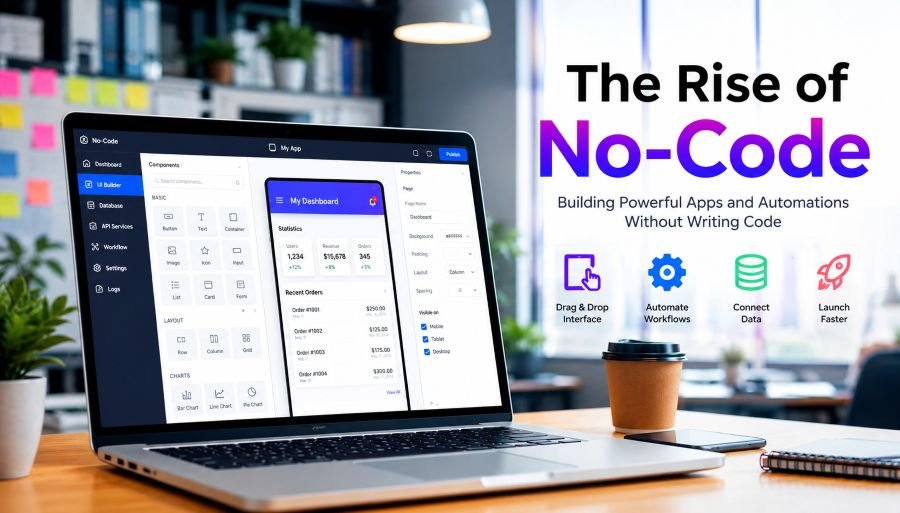
Introduction
For many years, building software meant learning programming languages, understanding databases, and spending months developing an application. Today, that picture is changing.
The Rise of No-Code is making digital creation available to people who may never have written a line of traditional computer code.
Business owners can create internal tools. Designers can build websites. Small teams can automate repetitive work. Entrepreneurs can test an app idea without first hiring a large development team.
Modern platforms use visual editors, ready-made components, workflows, integrations, and increasingly artificial intelligence to turn ideas into working digital products.
Google describes AppSheet as a true no-code platform that allows users to create applications and automated processes without writing traditional code. Microsoft and other major technology companies are also investing heavily in low-code and AI-assisted application development.
Quick Facts
| Topic | Quick Answer |
|---|---|
| What is no-code? | A way to build digital products mainly through visual tools instead of traditional programming |
| Who can use it? | Entrepreneurs, business teams, designers, marketers, students, and other non-developers |
| Common uses | Websites, business apps, databases, forms, dashboards, workflows, and automation |
| Main advantage | Faster development with a lower technical barrier |
| Role of AI | AI can help generate pages, logic, data structures, workflows, and complete application ideas |
| Popular examples | AppSheet, Bubble, Webflow, Microsoft Power Platform and similar tools |
| Does it replace developers? | Not completely; complex software may still need professional engineering |
| Main concerns | Customization, security, governance, scalability, pricing, and platform dependence |
What Does No-Code Mean?
No-code development means creating software through graphical tools instead of manually writing most or all of the underlying programming code.
A traditional developer may write commands to create a form, connect a database, process information, and display a result.
With a no-code platform, a user may achieve the same basic goal by selecting components, setting conditions, connecting data sources, and choosing actions from menus.
For example, someone could create a simple employee request application with:
- a form for entering information,
- a database for storing requests,
- an approval process,
- automatic email notifications,
- and a dashboard showing the status of each request.
The person building it may never need to write a conventional programming language.
Google AppSheet, for example, can automatically generate application prototypes and allows users to create more advanced behaviour with spreadsheet-style expressions.
Why Is No-Code Growing So Quickly?
Several changes have helped this type of development become more important.
Businesses Need Software Faster
Companies now depend on digital systems for almost every part of their work.
Sales teams need customer tools. Human resources departments need employee systems. Marketing teams need landing pages. Operations teams need dashboards. Managers want automated reports.
Traditional development teams cannot always build every small internal tool quickly.
No-code gives other employees a way to solve some of these problems themselves.
Microsoft says its Power Platform had more than 56 million monthly active users when reporting on the platform in 2025, showing the large scale that low-code development has already reached.
Small Businesses Have Limited Budgets
A custom software project can require developers, designers, testers, infrastructure specialists, and ongoing maintenance.
That may be too expensive for a small company or a new entrepreneur.
A visual development platform can lower the starting barrier.
Instead of creating an entire technical system from the beginning, users can work with existing infrastructure and ready-made tools.
This makes it easier to test whether an idea has real value before spending heavily on custom development.
People Expect Faster Results
Digital businesses move quickly.
An entrepreneur may want to launch a minimum viable product, collect feedback, change the design, and test a new version within weeks.
Visual tools make experimentation easier because many changes can be made directly through an editor.
A simple idea can sometimes move from a sketch to a usable prototype much faster than with a fully custom development process.
Artificial Intelligence Is Changing No-Code Again
AI may be the biggest new force behind the movement.
Earlier platforms mainly depended on drag-and-drop interfaces.
Now users can increasingly describe what they want in normal language.
For example:
Create a customer booking application with a login page, appointment form, customer database, and admin dashboard.
An AI-powered development system may use that request to begin producing the structure of the application.
Microsoft announced a new Power Apps experience in which makers can describe requirements through natural language while AI agents help create user stories, data models, APIs, forms, interface components, and other parts of an application.
Bubble also combines AI generation with visual editing for building web and mobile applications.
Webflow has similarly introduced AI-powered tools for generating and managing digital experiences, including technology aimed at helping users create full-stack web applications.
This creates an important shift.
The future may not simply be no-code versus code.
Instead, people may move between natural-language instructions, visual editors, AI-generated components, low-code tools, and traditional programming depending on the problem.
Who Is Using No-Code Tools?
The audience is much wider than professional developers.
Entrepreneurs
A founder can test an online service, marketplace, customer portal, booking system, or internal management tool before investing in a large engineering team.
Small Businesses
A small company may create inventory systems, order forms, customer databases, staff tools, and automatic notifications.
Marketing Teams
Marketers can create websites, campaign pages, forms, content systems, and experiments with less dependence on developers.
Webflow describes this type of user as a citizen web developer—someone without traditional technical skills who uses modern platforms to create web experiences.
Operations Teams
Employees who understand a business process often know exactly where work is being slowed down.
No-code automation allows them to connect systems and reduce repetitive manual tasks.
Professional Developers
No-code and low-code are not only for beginners.
Experienced programmers can also use these platforms to build standard parts of a project more quickly and then spend more time on difficult engineering problems.
Why Companies Like No-Code Development
The attraction is easy to understand.
Faster Prototypes
Teams can test an idea before building a large custom system.
Lower Technical Barrier
People do not need years of programming experience to begin creating useful tools.
Easier Changes
Visual interfaces can make small modifications simpler for business teams.
Automation
Platforms can connect forms, databases, APIs, emails, spreadsheets, and business applications.
Google, for example, says AppSheet Automation can connect with APIs, data sources, webhooks, and existing software.
Greater Independence
Departments can sometimes solve small problems without placing every request into an already busy software development queue.
That independence can be useful when it is supported by good security and governance rules.
Is No-Code the Same as Low-Code?
The terms are related, but they are not exactly the same.
No-code normally aims to let a person create a product with little or no traditional programming.
Low-code still reduces the amount of manual programming but allows developers to add more custom logic when needed.
The difference is becoming less clear as platforms become more powerful.
A project may begin with an AI prompt, continue through a visual editor, use built-in automation, and later include custom code.
Because of this, modern software development is becoming more flexible rather than fitting into one simple category.
The Limits of No-Code
The technology is powerful, but it is not the perfect answer for every project.
Complex Customization
A highly specialised application may need behaviour that a visual platform does not easily support.
Vendor Dependence
When a company builds deeply inside one platform, moving the complete system somewhere else may be difficult.
This is often called vendor lock-in.
Recent research into zero-code AI development tools has identified customization, scalability, reliability, and platform dependence as important trade-offs compared with traditional development.
Costs Can Change as a Product Grows
A platform that is affordable for a small prototype may have different costs when thousands of users begin using the application.
Businesses should understand pricing before making a platform central to their operations.
Security Still Matters
Removing code does not remove security risks.
Applications may contain customer information, employee details, financial records, passwords, or business data.
Access control, permissions, backups, privacy rules, and data management remain important.
Governance Becomes More Important
If hundreds of employees can create apps and automations, a company needs to know what is being built, what data is being used, and who is responsible for each system.
This is one reason major enterprise platforms continue to expand administration and governance features. Microsoft, for example, has added tools for managing applications, automations, AI agents, policies, sharing, security, and usage.
Will No-Code Replace Software Developers?
Probably not.
It is more useful to think of no-code as expanding the number of people who can create software.
Professional engineers are still needed for complicated architecture, cybersecurity, performance optimisation, advanced integrations, infrastructure, large-scale systems, and unusual technical requirements.
Developers may also become responsible for guiding and extending systems that other teams begin with visual tools.
AI faces similar limits.
Research continues to show that generating an entire reliable software system is much harder than producing small pieces of code. One 2025 benchmark of AI models building complete Android applications found substantial difficulty with real-world, multi-component software development.
So the likely future is cooperation.
Business users understand their problems.
No-code tools help them express solutions.
AI speeds up creation.
Developers handle the areas where deeper technical control is required.
No-Code and the Future of Entrepreneurship
One of the most interesting effects may be the reduction of barriers to starting a technology business.
In the past, a founder with a good software idea often needed a technical co-founder or money to hire developers before the idea could become real.
Today, some founders can create a prototype themselves.
They can show it to users.
They can learn what customers actually want.
Then they can decide whether the product deserves greater investment.
This does not mean building a successful technology company has become easy.
Finding customers, designing a useful product, protecting data, creating a business model, and competing in a crowded market remain difficult.
But the cost of turning an idea into something people can actually test is becoming lower.
That is a major change.
What Comes Next?
The next stage of the movement will probably be less focused on dragging boxes around a screen and more focused on conversation.
A person may explain a business problem.
AI will propose an application.
The user will change parts visually.
Specialised agents may create workflows, connect data, test functions, and suggest improvements.
Professional developers will step in where deeper control is necessary.
Research into natural-language no-code systems is already exploring how AI agents and visual workflows can help non-experts create digital services more easily.
The line between programmer and non-programmer may therefore become less important.
Knowing what problem to solve, how a process should work, and how users should experience a product could become just as valuable as knowing the exact syntax required to build it.
Final Thoughts
The Rise of No-Code is not simply about making programming easier.
It represents a larger change in who is allowed to build technology.
A shop owner can automate a process. A designer can create an interactive website. A manager can build an internal tool. A founder can test an application idea. A developer can produce routine parts of a project faster.
Artificial intelligence is pushing this change even further by allowing people to describe software in normal language.
No-code will not remove the need for skilled developers, and it does not remove questions about security, scalability, cost, governance, or technical quality.
What it does is lower the door.
More people can move from having an idea to building something useful.
And that may be the most important reason no-code continues to grow.
Frequently Asked Questions
What is the rise of no-code?
It describes the growing use of visual and AI-powered platforms that allow people to create applications, websites, workflows, and other digital products without traditional programming.
Can I build an app without coding?
Yes. Platforms such as Google AppSheet and Bubble allow users to create many types of applications through visual tools, automation, data connections, and AI-assisted features.
Is no-code good for beginners?
It can be a useful starting point because users can focus on logic, design, and workflows instead of first learning a programming language.
Is no-code suitable for large companies?
It can be. Enterprise platforms now include security, governance, administration, integration, and scalability features, although companies still need strong technical oversight.
What is the biggest no-code trend now?
One of the most important developments is the combination of no-code platforms with generative AI, allowing users to begin creating software through natural-language instructions.
Will AI and no-code replace programmers?
They are more likely to change developers’ work than eliminate it. Complex systems still require engineering knowledge, security expertise, architecture, testing, and custom development.
