


Introduction
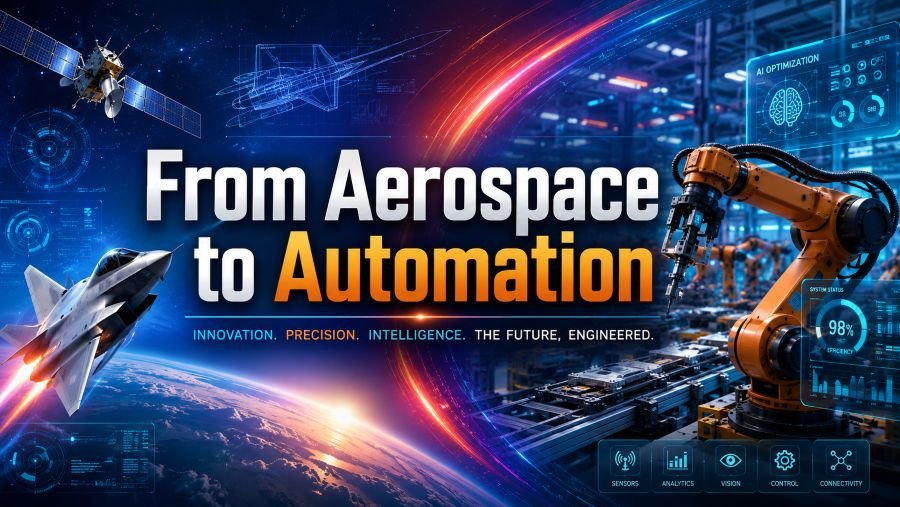
From Aerospace to Automation describes how technologies originally developed for aircraft, spacecraft, and space missions are now being used in factories and other industries.
Aerospace engineering requires high accuracy, strong safety systems, reliable machines, and advanced computer control. These same qualities are also important in modern automation. As a result, aerospace technologies such as robotics, computer vision, digital twins, artificial intelligence, and advanced sensors are helping companies improve manufacturing.
NASA actively makes some of its robotics, automation, and control technologies available for commercial development. At the same time, global demand for factory robots continues to grow. The International Federation of Robotics reported that approximately 542,000 industrial robots were installed worldwide in 2024, more than twice the number installed ten years earlier.
What Does “From Aerospace to Automation” Mean?
The phrase does not mean that aircraft are being turned into factory machines.
It means that ideas, tools, software, materials, and engineering methods developed for aerospace projects can be adapted for industrial use.
For example, a robotic system created to handle equipment in space may later help a factory move delicate components. A camera system designed to guide a spacecraft robot may be adapted to inspect manufactured products.
NASA describes a commercial spinoff as a product or service that uses NASA technology, knowledge, or expertise. This can include companies using NASA-developed technology inside their manufacturing processes.
Why Aerospace Technology Is Valuable
Aircraft and spacecraft operate in difficult environments. Their systems must continue working despite vibration, pressure changes, extreme temperatures, limited access, and communication delays.
Because failure can be costly or dangerous, aerospace engineers focus heavily on:
- Precision
- Reliability
- Safety
- Lightweight design
- Remote control
- Accurate testing
- Real-time monitoring
- Efficient use of energy
Factories need many of the same qualities. A production line must operate accurately, protect workers, reduce waste, and produce items of consistent quality.
This shared need creates a natural connection between aerospace engineering and industrial automation.
Aerospace Robotics in Modern Factories
Robots are one of the clearest links between aerospace and automation.
Space agencies use robots because many locations are too dangerous or distant for humans. Robots can explore planets, move equipment, inspect spacecraft, and complete repair work.
Factories use robots for similar reasons. They can lift heavy objects, enter dangerous areas, repeat accurate movements, and work with materials that may be unsafe for people.
NASA’s Robonaut 2 was developed with both space and industrial uses in mind. NASA needed a robotic astronaut assistant, while General Motors was interested in a robot capable of working in industrial environments. Its technology was designed to use human tools, change tasks, and perform work requiring controlled force.
This type of technology can support factory activities such as:
- Component assembly
- Machine loading
- Product inspection
- Tool handling
- Welding
- Packaging
- Maintenance
- Hazardous material handling
Computer Vision and Automated Inspection
Computer vision allows machines to understand information from cameras.
A computer vision system can identify an object, measure its position, find damage, or check whether a product has been assembled correctly.
NASA developed computer vision software to help operators guide robotic arms toward targets on the International Space Station. The system uses camera information and machine learning to estimate an object’s position. NASA says the technology may also be useful for industrial automation and robots working outside controlled environments.
Similar systems can be used in factories to find:
- Cracks in metal
- Missing components
- Incorrect labels
- Surface damage
- Poor welds
- Product size differences
- Assembly mistakes
A NASA-supported artificial intelligence system developed from research into planetary rover navigation has also been adapted to identify product defects during manufacturing.
Automated inspection can examine products continuously. However, human experts are still needed to train the system, review unusual cases, and make important quality decisions.
Digital Twins and Virtual Factories
A digital twin is a virtual model connected to a real product, machine, or manufacturing process.
Engineers can use it to understand what is happening inside a system without stopping the physical machine. They can also test changes in the virtual model before making those changes in the real world.
Digital twins have strong roots in complex engineering fields such as aerospace. Aircraft and spacecraft contain many connected systems, making computer-based testing and simulation extremely valuable.
Today, manufacturers use digital twins to:
- Predict machine problems
- Test production changes
- Improve product quality
- Reduce downtime
- Train workers
- Study energy use
- Plan maintenance
- Find production delays
The US National Institute of Standards and Technology says digital twins can help increase production, improve quality, and lower manufacturing costs. However, it also notes that companies need reliable data, common standards, and trustworthy methods for testing digital models.
Artificial Intelligence in Automation
Artificial intelligence helps automated systems study information and make useful predictions.
A traditional automated machine normally follows fixed instructions. An AI-supported system can examine sensor data, identify patterns, detect unusual behaviour, and adjust certain actions.
In aerospace and manufacturing, AI may be used for:
- Predictive maintenance
- Automated inspection
- Route planning
- Robot navigation
- Supply-chain management
- Energy optimisation
- Production scheduling
- Fault detection
NIST’s 2026 roadmap for smart manufacturing identifies advanced sensing, autonomous systems, digital twins, robotics, supply-chain optimisation, and additive manufacturing as important areas where AI is supporting industrial development.
AI does not remove the need for people. Engineers must decide how the system should work, check its results, protect its data, and make sure its decisions remain safe.
Advanced Sensors and Real-Time Monitoring
Aerospace vehicles contain sensors that measure temperature, pressure, movement, speed, vibration, and many other conditions.
Modern factories use similar sensors to monitor machines and production lines.
For example, a vibration sensor may warn that a motor is beginning to fail. A temperature sensor may detect overheating. A 3D camera may help a robot understand the shape and location of an object.
This information allows maintenance teams to respond before a small problem becomes a major breakdown.
Advances in sensors, software, and vision systems are also making robotics more accessible to smaller manufacturers, not only large international companies.
Precision Manufacturing
Aerospace parts must often meet strict measurements. A small error can affect safety, performance, fuel use, or the ability of several parts to fit together.
This focus on precision has influenced many other industries, including:
- Automotive manufacturing
- Medical equipment
- Electronics
- Semiconductor production
- Renewable energy
- Industrial machinery
- High-quality metal production
Automated measuring tools, laser scanners, robotic inspection systems, and computer-controlled machines can help manufacturers produce more consistent parts.
The aim is not simply to make products faster. It is to make them correctly, repeatedly, and with less wasted material.
Additive Manufacturing
Additive manufacturing, commonly called 3D printing, creates an object layer by layer.
The technology is useful in aerospace because engineers can produce complex shapes while reducing material waste and the number of separate components.
In industrial automation, 3D printing may be used to produce:
- Lightweight components
- Custom tools
- Robot grippers
- Replacement parts
- Product prototypes
- Small production batches
Digital models can be sent directly to suitable manufacturing equipment. This can shorten development time and make customised production easier.
However, important components must still pass strict testing. Their strength, shape, materials, and manufacturing records must be carefully checked.
How Automation Is Changing Aerospace
The connection works in both directions.
Aerospace technology improves industrial automation, while factory automation also improves aerospace production.
Aircraft and spacecraft manufacturers use automated systems for tasks such as:
- Drilling accurate holes
- Moving large components
- Applying coatings
- Inspecting surfaces
- Building composite structures
- Testing electronic systems
- Tracking tools and materials
- Transporting parts around facilities
Automation can improve consistency, but aerospace production is complex. Many components are produced in relatively small numbers, and designs may change between different aircraft models.
For this reason, flexible robots and human-robot cooperation can be more useful than completely fixed production lines.
Main Benefits of Moving From Aerospace to Automation
Better Accuracy
Robots and computer-controlled machines can repeat the same movement with high consistency.
Improved Safety
Machines can perform dangerous, heavy, or repetitive work while people supervise the process from a safer location.
Faster Inspection
Cameras and sensors can check products during production instead of waiting until the entire process is complete.
Lower Waste
Accurate measurement and better process control can reduce damaged materials and rejected products.
Predictive Maintenance
Sensor information can help companies repair equipment before it fails.
Greater Flexibility
Modern robots can sometimes be reprogrammed for new products or production tasks.
Challenges That Companies Must Consider
Moving aerospace technology into everyday industrial use is not always simple.
High Starting Costs
Robots, sensors, software, and specialist equipment can require a large initial investment.
Difficult Integration
New automation must work with existing machines, computer systems, and production methods.
Data Quality
AI and digital twins need accurate information. Poor data can produce unreliable predictions.
Cybersecurity
Connected factories may face digital attacks. Important production systems must be protected.
Worker Training
Employees need training to operate, maintain, and safely work around automated equipment.
Safety During Maintenance
Robots may reduce exposure to dangerous daily tasks, but risks can still arise during programming, testing, setup, adjustment, or maintenance. OSHA reports that many robot-related accidents happen during these non-routine activities.
Automation must therefore include safety barriers, emergency controls, risk assessments, clear procedures, and properly trained workers.
Careers From Aerospace to Automation
This growing connection is creating opportunities for people with different technical skills.
Important career areas include:
- Aerospace engineering
- Mechanical engineering
- Electrical engineering
- Robotics
- Mechatronics
- Software development
- Artificial intelligence
- Data analysis
- Cybersecurity
- Quality control
- Systems engineering
- Industrial maintenance
A person trained in aerospace may work in robotics, manufacturing, automotive technology, energy, or advanced materials. In the same way, an automation engineer may find opportunities in aircraft production, drone development, satellite systems, or space technology.
The common skills are problem-solving, accurate design, safe system operation, and the ability to connect mechanical and digital technology.
The Future of Aerospace and Automation
The future will likely bring closer cooperation between people, robots, and intelligent software.
Factories may use more collaborative robots that work near trained employees. Autonomous mobile robots may move tools and materials. Digital twins may represent entire production facilities. AI may help engineers detect faults earlier and improve production schedules.
NASA continues to offer technologies involving autonomous robots, drones, machine learning, advanced control systems, and robotic construction for possible commercial development.
However, the goal should not be automation for its own sake. Technology should solve a real problem, improve safety, support workers, increase quality, or reduce unnecessary waste.
Frequently Asked Questions
What is the meaning of From Aerospace to Automation?
It refers to the transfer and adaptation of engineering methods and technologies from aircraft and space projects to factories, robotics, and automated industrial systems.
How does aerospace technology help automation?
It provides advanced robotics, sensors, computer vision, lightweight materials, control software, simulation tools, and strict quality methods.
Are aerospace robots used in factories?
Some robotic technologies are developed for both aerospace and industrial purposes. Other space-related systems are later adapted for inspection, assembly, navigation, or hazardous work.
Will automation replace every factory worker?
No. Automation usually changes the type of work people perform. Humans are still needed for planning, maintenance, programming, safety, creativity, problem-solving, and important decisions.
Why is precision important in both industries?
Aircraft, spacecraft, and factory products depend on parts fitting and operating correctly. Accurate manufacturing improves safety, quality, performance, and reliability.
What technologies will shape future automation?
Artificial intelligence, digital twins, collaborative robots, computer vision, autonomous mobile robots, advanced sensors, and additive manufacturing are expected to remain important.
Conclusion
From Aerospace to Automation represents the movement of high-level engineering into practical industrial work.
Technologies designed for space missions and aircraft are helping factories inspect products, guide robots, predict equipment problems, reduce waste, and protect workers. At the same time, advances in factory automation are helping aerospace companies manufacture increasingly complex systems.
The strongest future will combine the accuracy of aerospace engineering, the speed of automation, and the judgement of skilled people. Companies that introduce these technologies carefully can build safer, more flexible, and more reliable production systems.
