



Introduction
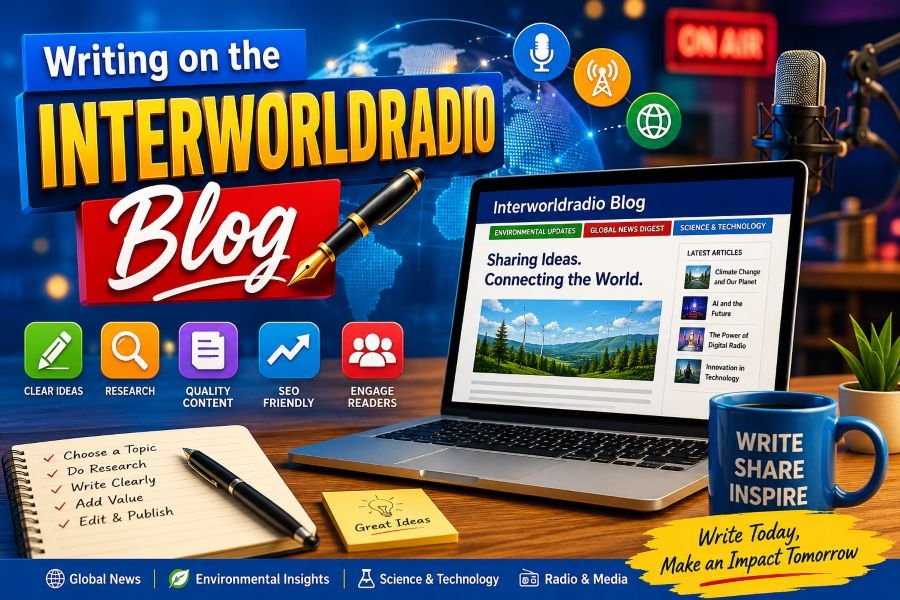
Writing on the Interworldradio Blog means creating clear, useful, and engaging content for readers interested in global news, environmental issues, science, technology, digital media, radio, and other modern subjects.
The platform’s main public sections include Environmental Updates, Global News Digest, and Science & Technology. Its homepage also displays articles covering communication, online entertainment, artificial intelligence, business technology, media, and digital culture.
Good writing for this type of blog is not simply about placing keywords in an article. A successful post should answer a real question, explain the subject clearly, use trustworthy sources, and give readers something valuable to remember.
This guide explains how to approach writing on the Interworldradio Blog, from selecting a topic to editing and publishing a complete article.
What Is the Interworldradio Blog?
Interworldradio.net presents itself as an online publishing platform covering stories and developments from around the world. Its About page says the team focuses on environmental sustainability, scientific developments, technological progress, and international affairs.
The website also publishes content beyond those core sections. Readers may find posts about digital communication, media, online tools, business technology, entertainment, radio, and emerging internet trends.
This variety gives writers many possible subjects. However, every article should still have a clear purpose and a strong connection to the interests of the website’s audience.
Why Are People Interested in Writing on the Interworldradio Blog?
People may search for this topic because they want to understand:
- What subjects are suitable for the platform
- How its articles should be structured
- Whether it accepts outside contributions
- How to contact its editorial team
- How to write content that is useful and search-friendly
The website has a public contact page with fields for a writer’s name, email address, subject, and message. However, the public pages reviewed for this article did not provide a detailed contributor checklist covering word count, payment, ownership, or editorial review. Writers should therefore contact the website directly before preparing a guest submission.
Understand the Audience Before Writing
Every strong article begins with the reader.
Before writing, think about the type of person who may search for the topic. A science article may attract students and curious readers. A technology guide may be useful to beginners, professionals, or business owners. A global news article may serve people looking for a simple explanation of a complicated event.
Ask three basic questions:
- What does the reader want to know?
- What problem are they trying to solve?
- What information would make the article genuinely useful?
The answers will help you choose the right tone, length, examples, and level of detail.
A beginner-friendly article should explain unfamiliar words. A technical article can include more detail, but it should still remain organised and easy to follow.
Choose a Topic That Matches the Platform
A suitable topic should match at least one recognised area of the website.
Possible subjects include:
Environmental Updates
Writers can explore climate change, renewable energy, wildlife protection, pollution, water conservation, sustainable farming, recycling, or green technology.
Global News and Public Issues
Articles may explain important international developments, humanitarian issues, major social changes, diplomacy, education, or economic events.
Science and Technology
Suitable topics include artificial intelligence, space exploration, medical research, consumer devices, digital security, robotics, communication technology, and sustainable innovation.
Radio, Audio, and Digital Media
Some existing Interworldradio content discusses radio, music, audio storytelling, media trends, and online communication. Writers interested in these subjects can create guides, explainers, interviews, or industry-focused articles.
The strongest topic is usually one that matches the platform while also answering a specific question.
For example, “Artificial Intelligence” is very broad. “How AI Tools Help Small Radio Stations Create Local News” is clearer and more useful.
Research the Topic Carefully
Research is one of the most important parts of writing on the Interworldradio Blog.
Do not depend on a single low-quality website. Look for original reports, government publications, official company pages, recognised universities, scientific papers, direct interviews, and established news organisations.
When researching, record:
- Important names
- Exact dates
- Verified numbers
- Official job titles
- Direct source links
- Areas where sources disagree
- Information that may change over time
Check every major fact before publishing. This is especially important when writing about health, finance, politics, science, laws, public figures, or breaking news.
Never add an impressive number simply because another blog has used it. Trace the claim to its original source whenever possible.
Create a Clear Article Structure
Readers should understand the article without working hard.
A simple structure may include:
Title
The title should describe the subject accurately. It should be interesting, but it should not make an exaggerated promise.
Subtitle
A subtitle gives readers more context and explains what they will learn.
Introduction
The introduction should answer the main question quickly. Avoid spending several paragraphs building suspense.
Main Sections
Divide the subject into logical sections. Each heading should cover one clear idea.
Examples
Real examples make complicated information easier to understand.
Conclusion
The final section should summarise the most important lesson without repeating the full article.
Frequently Asked Questions
FAQs can answer smaller questions that do not require full sections.
Google recommends using unique, clear titles and organising long content with paragraphs and descriptive headings. It also says useful, easy-to-read, original content can have more influence than many minor SEO techniques.
Write a Strong Introduction
The introduction is often the first test of an article.
Readers should quickly understand:
- What the topic is
- Why it matters
- What the article will explain
- Whether the information matches their search
Avoid openings such as:
“Since the beginning of time, communication has always been important.”
This sentence is broad and does not help the reader.
A better opening would be:
“Writing on the Interworldradio Blog requires a clear topic, reliable research, simple language, and a structure that helps readers find answers quickly.”
The second version directly addresses the keyword and explains the article’s purpose.
Use Simple and Natural Language
Simple writing is not weak writing.
Short sentences can make difficult subjects easier to understand. Common words usually work better than complicated alternatives. Technical terms should only be used when they are necessary.
For example:
Complicated: “The implementation of technological innovations facilitates enhanced communication efficiency.”
Simple: “New technology can make communication faster and easier.”
Writers should also avoid repeating the main keyword in every paragraph. Google warns that excessive keyword repetition can create a poor experience and may conflict with its spam policies.
Use the main keyword naturally in the title, introduction, one or two headings, conclusion, and SEO information where it makes sense.
Add Original Value
A new article should do more than rewrite the first search result.
Original value may come from:
- A clearer explanation
- New research
- An expert comment
- A useful comparison
- A real example
- A step-by-step process
- Updated information
- A different perspective
- A practical checklist
Google’s people-first content guidance asks whether a page provides original information, useful analysis, clear sourcing, and greater value than competing results.
Before publishing, ask:
“Why should someone read this article instead of the ten similar articles already online?”
The answer should be visible in the content.
Use SEO Without Damaging Readability
SEO helps search engines understand an article, but readers must remain the main priority.
A basic SEO plan should include:
- One clear primary keyword
- Related questions and phrases
- A descriptive page title
- A short URL slug
- A useful meta description
- Logical headings
- Relevant internal links
- Trustworthy external sources
- Descriptive image alt text
- A direct answer near the beginning
Google says creators should use words that people would naturally use to find the content. These words can appear in important locations such as the title, main heading, link text, and image alt text.
However, there is no special keyword formula that guarantees a top position. Helpful information, originality, trust, technical accessibility, and reader satisfaction all matter.
Use Helpful Links
Links can strengthen an article when they genuinely help the reader.
Internal links guide visitors to related content on the same website. For example, an article about renewable energy could link to an earlier post about solar panels or climate policy.
External links should lead to reliable evidence, such as an official report, research institution, government agency, or respected publication.
Use descriptive anchor text. Instead of writing “click here,” explain what the linked page contains.
Do not add unrelated links simply to increase their number. Every link should support the surrounding paragraph.
Add Useful Images
Images can make an article more engaging and easier to understand.
A writer may include:
- A relevant featured image
- An infographic
- A chart
- A screenshot
- A map
- A photograph of the subject
- A simple explanatory diagram
Google recommends placing high-quality images near relevant text and adding descriptive alt text that explains how the image relates to the page.
An effective alt description for this article might be:
“Writer preparing an article for the Interworldradio Blog on a laptop.”
Avoid alt text that is only a list of repeated keywords.
Edit Before Publishing
The first draft should not be the final draft.
During editing, check:
- Is the main question answered early?
- Are all facts supported?
- Are any claims exaggerated?
- Is the introduction too long?
- Are the headings clear?
- Are paragraphs easy to scan?
- Is any information repeated?
- Are names and dates correct?
- Do the links work?
- Does the conclusion provide a clear takeaway?
Reading the article aloud can reveal awkward sentences and missing words.
It is also helpful to leave the draft for a short time before editing. Returning with fresh attention makes errors easier to notice.
Common Mistakes to Avoid
Copying Other Articles
Copied or lightly rewritten content does not provide real value. Research the subject, understand it, and explain it in your own words.
Writing Only for Search Engines
An article filled with repeated keywords may be difficult to read. Write for people first.
Using Weak Sources
Anonymous websites and copied statistics can damage trust. Use primary or highly reliable sources whenever possible.
Making the Introduction Too Long
Readers should not have to scroll through several empty paragraphs before finding the answer.
Publishing Unverified Claims
Do not present rumours, guesses, or promotional statements as established facts.
Ignoring Updates
Technology, laws, prices, public roles, and statistics can change. Review older articles and update them when necessary.
Assuming Submission Rules
A public contact form does not automatically confirm that a website accepts every guest article. Ask about topic approval, word count, editing, links, payment, and content ownership before submitting work.
A Simple Writing Process
A practical workflow for writing on the Interworldradio Blog may look like this:
- Select a focused topic.
- Identify the reader’s main question.
- Study related articles on the website.
- Collect information from reliable sources.
- Prepare a simple outline.
- Write the direct answer first.
- Add supporting details and examples.
- Include natural keywords.
- Check every important fact.
- Edit for clarity and accuracy.
- Add the title, meta description, links, and image details.
- Contact the website about current submission requirements.
Following a repeatable process can improve quality and reduce mistakes.
Frequently Asked Questions
What does writing on the Interworldradio Blog mean?
It means preparing useful and readable articles that match the website’s content areas, such as global affairs, environmental topics, science, technology, radio, media, and digital trends.
What topics appear on Interworldradio.net?
Its main public sections include Environmental Updates, Global News Digest, and Science & Technology. The homepage also contains posts on media, communication, online entertainment, artificial intelligence, business technology, and other subjects.
Does Interworldradio accept guest posts?
The website provides a public contact form, but the pages reviewed for this article did not show a complete guest-post policy. Writers should ask the website directly about current opportunities and requirements.
How long should an Interworldradio article be?
There is no verified public word-count rule on the pages reviewed. The correct length depends on the topic. The article should be long enough to answer the reader’s questions without adding unnecessary paragraphs.
Is SEO important for Interworldradio content?
Yes, SEO can help people discover an article. However, keywords should be used naturally. Clear structure, original information, trustworthy sources, and a useful answer are more important than repeating the same phrase.
Can AI be used to prepare an article?
AI can help create an outline, suggest headings, or improve grammar. However, a writer should still verify every claim, remove generic wording, check sources, and add original human value. Google says content should be judged by its quality rather than simply by the method used to create it.
Conclusion
Writing on the Interworldradio Blog requires more than basic writing ability. A strong article needs a focused topic, reliable research, a direct introduction, simple explanations, logical headings, natural SEO, and careful editing.
Writers should study the website’s existing sections and understand the needs of its readers before preparing an article. They should also use the public contact page to confirm current submission rules rather than assuming that every topic or guest post will be accepted.
The best content does not exist only to attract clicks. It gives readers a useful answer, presents accurate information, and makes a complicated subject easier to understand.
